

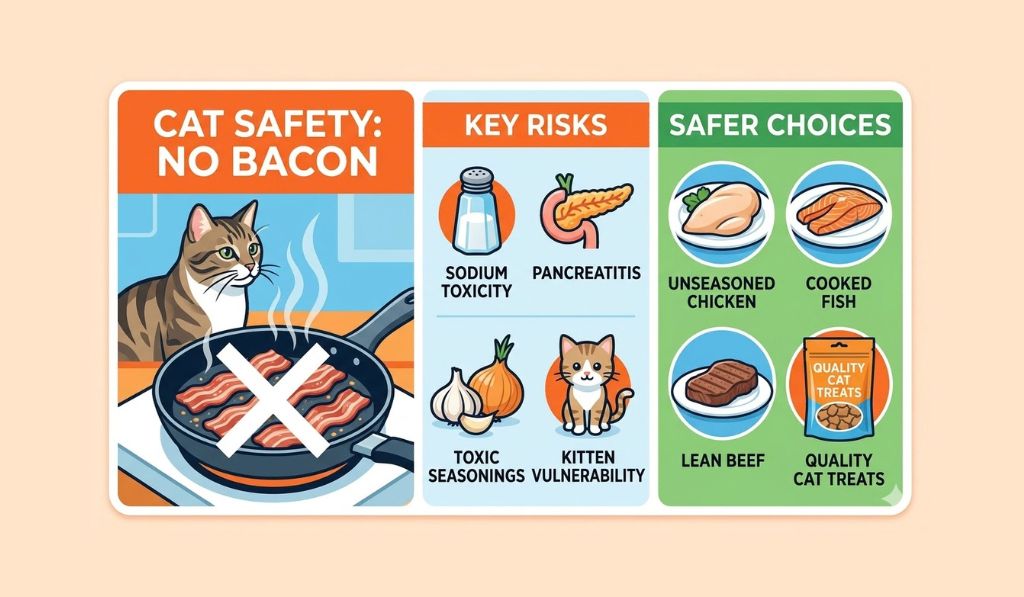
You are making bacon on a Sunday morning, and your cat pops out and glares at the pan terribly. It occurs in nearly any family. But, before you give them a strip, it is well to inquire whether cats can safely eat bacon or whether you should entirely shun the matter and put it out of their reach.
The answer to this question is no, cats do not need to eat bacon on a regular basis. Although even a single bite is accidental and unlikely to take your cat to the emergency vet, bacon is a processed pork product that contains a lot of salt, saturated fat, and usually poisonous seasonings that can cause severe damage to your cat in the long run.
This paper discusses all you should know, including the reasons why bacon is a favourite with cats, dangers it poses, and how you should feed them instead.
Why Cats Are Drawn to Bacon
Cats are forced carnivores. They are constructed out of animal protein consumption in their biology. They have a highly sensitive nose that picks up the scent of meat-based food, and bacon is one of the most attractive food smells in the kitchen.
With all that being said, attraction and being able to safely consume something are not the same thing. Cats do not metabolise high-sodium, high-fat food as humans do. Their digestive systems and kidneys work in a very different manner. The mere fact that a cat prefers bacon does not imply that it is good to a cat.
What Is Bacon Actually Made Of?
Is bacon processed pork? Yes, it is. Bacon is made of pork belly or back cuts, which undergo the process of curing, salting, and smoking and, in some cases, the use of chemicals to preserve the meat. That is what makes it have its unique taste and long shelf life.
It is the same processing that causes it to be dangerous to your cat. The following is the contents of a common piece of bacon:
- Very high sodium (one slice of food may contain 150 to 200 mg of salt)
- High saturated fat content
- Crude nitrates and preservatives
- Seasonings can contain black pepper, onion powder, sugar or garlic powder
All these ingredients pose a unique form of threat to your cat, as we are going to discuss below.
Is Bacon Bad for Cats? Key Health Risks
1. Sodium Toxicity
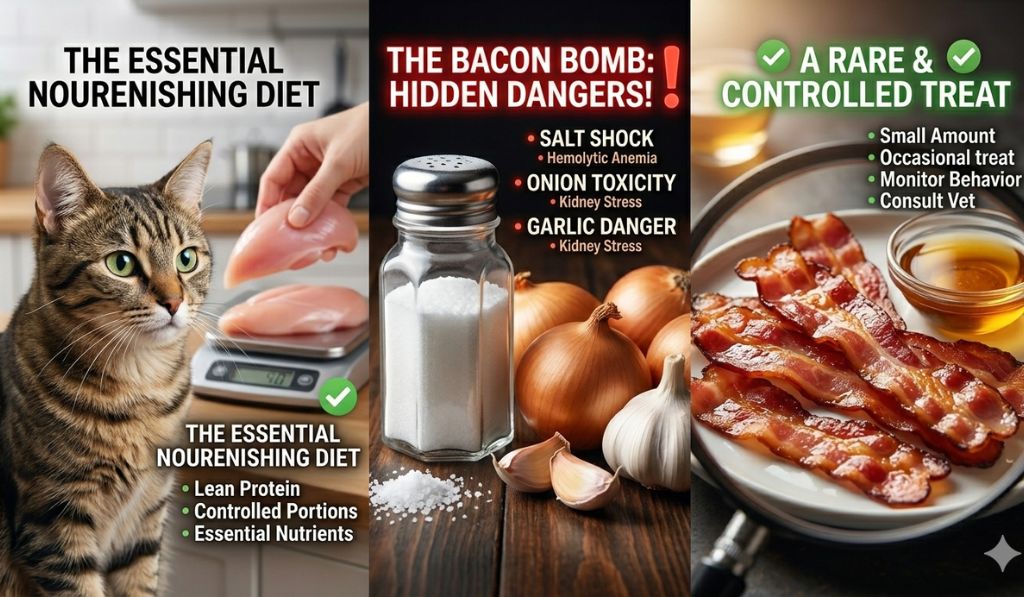
This is the greatest threat in the short run. Cats are very sensitive to salt. According to clinical veterinary reports, a dose of half a teaspoon of salt can be toxic to a cat with a weight of 10 pounds or less. Even a couple of strips of bacon may provide a lethal dose of sodium.
In cats, the symptoms of salt poisoning are:
- Excessive thirst
- Urination
- Vomiting
- Diarrhoea
- Shaking
- In severe cases, seizures or death
2. Fatty Food and Pancreatitis
Bacon is among the fatty processed meats. Cats that feed on large quantities of fat on a regular basis are at risk of developing pancreatitis, a very serious risk, and this is a painful and potentially fatal inflammation of the pancreas. A high-fat meal alone can cause an episode in cat systems that are sensitive.
Obesity also is caused by fat overload, and in cats it causes:
- Diabetes
- Joint problems
- Liver diseases (hepatic lipidosis)
3. Garlic and Onion Toxicity
Many bacon products are seasoned or cured with garlic powder or onion powder. Both belong to the allium family and are highly toxic to cats. Even tiny amounts can damage red blood cells and lead to hemolytic anemia. This is one reason why checking the bacon label matters before your cat gets anywhere near it.
4. Nitrates and Preservatives
Processed bacon contains sodium nitrate and other curing agents. While research on their effects specifically in cats is limited, the general consensus among veterinarians is that these additives offer no nutritional benefit and may contribute to long-term cellular stress.
5. Long-Term Organ Damage
Feeding cats salty, fatty, processed foods regularly stresses the kidneys, liver, and cardiovascular system. Cats with pre-existing kidney disease or heart conditions are especially vulnerable. Even healthy cats can develop chronic issues if their diet includes processed human foods on a regular basis.
Can Cats Have Bacon Occasionally?
A tiny bit of plain cooked bacon free of seasoning would not be very likely to do any instant harm to a healthy adult cat. The important point is “small,” that is, not more than a bite, and “occasionally,” that is, not every week.
But nothing is really healthy about feeding your cat bacon. It is a source of protein, of course, but not in a form that is nutritionally valuable or balanced as far as cats are concerned. Risks are more than any reward.
Bacon must never be given to kittens. Their systems are much more sensitive, and their kidneys cannot process excess sodium whatsoever.
What About Bacon Grease?
My cat ate bacon grease. Is that a problem? Yes, it can be. Bacon grease is nothing more than a hit of saturated fat that is highly concentrated, coupled with a dose of sodium. When your cat licks the pan or gets into drippings, a cat will vomit, have diarrhoea, and become lethargic. One or two licks are harmless; no more than a large scale might lead to stomach troubles or pancreatitis.
Store pans and grease containers out of sight. Cats are great counter climbers.
What of the Rest of the Processed Meats?
Because this question is frequently accompanied by others, the following is an immediate answer:
| Processed Meat | Safe for Cats? | Main Risk |
|---|---|---|
| Bacon | No (avoid regularly) | Salt, fat, seasonings |
| Ham | No (avoid) | Extremely high sodium |
| Salami | No | Salt, garlic powder, fat |
| Pepperoni | No | Salt, spices, fat |
| Bologna / Baloney | No | Preservatives, fat, salt |
| Turkey Bacon | No (not much better) | Still high sodium |
| Prosciutto | No | Very high salt content |
| Summer Sausage | No | Salt, spices, preservatives |
| Deli/Sandwich Meat | No | High sodium, additives |
| Beef Jerky | No | Extremely high sodium |
You see that it is not that particular to bacon. All the groups of cured and processed meat are not suitable for cats. Cats may be fed meat; however, it must be plain, cooked, and devoid of additives.
Cats: Safer Protein Choices
In case you would like to share something meaty with your cat, you should be able to use these ones:
- Unseasoned plain boiled chicken (no skin)
- Cooked turkey (no onion and garlic stuffing)
- Cooked lean beef (unseasoned)
- Cooked tuna or salmon (not always on a regular basis)
- Commercial cat treats that are prepared using real meat and are designed to meet the health needs of cats
Any commercial treat should be read before purchasing it. Find familiar examples of protein sources as the first ingredient, and do not purchase the products that contain a garlic extract, onion powder, artificial colouring’s, or an excessive amount of sodium.
“Can cats eat bacon?” is a question that arises in the midst of a bigger discussion on cats and human food in general. The rule is as follows: the cats are fed on clean and species-fit animal protein. The more we process a food, the less it should be included in the bowl of your cat.
How to Deal With Your Cat Chewing Bacon
In case your cat took a piece of bacon off your plate, keep yourself together. A single slice of simple bacon is not likely to be a big trouble. Follow-up on them during the next couple of hours. Monitor vomiting, excessive thirst, sleepiness, or litter box behavior.
Call your veterinarian immediately in case your cat has already:
- Consumed a lot of food
- Consumed too much seasoned or garlic-flavored bacon
- Already having problems with its kidneys or heart
Wait not until the symptoms become severe.
Ensure that there is availability of fresh water. The water aids in quickening the process through which the kidneys process and remove extra sodium.
FAQ:
Can cats have raw bacon?
No. Crude bacon also runs the risk of bacterial contamination such as Salmonella and Listeria, as well as all the sodium and fat issues as cooked bacon. There is also a low risk of the presence of Trichinae parasites in raw pork. Do not feed your cat raw or half baked pork products.
Can kittens eat bacon?
No. Kittens are even more sensitive to sodium as compared to adult cats. Their kidneys are immature and their bodies are not in a good position to handle the salt, fat, or preservatives contained in bacon. Keep processed meat out of the pants of kittens.
Can cats have turkey bacon?
Turkey bacon remains a processed meat. It is usually composed of almost as much sodium as ordinary bacon and has, like it, preservatives and seasonings. It neither is a safe nor healthy substitute for cats.
Can cats have bacon grease?
No. Bacon grease is condensed fat and salt. Although a minute, unintended lick will not bring much harm, constant exposure or a bigger dosage will bring about digestive disturbances, pancreatitis, or sodium-related diseases. Keep grease away from cats.
Is ham bad for cats?
Yes. Ham contains one of the largest quantities of sodium of any deli meat. A constant consumption of ham by cats exposes them to salt poisoning, kidney stress, and obesity. One can eat a small portion of unseasoned ham, which is not actually harmful (though again there is no health benefit).
Can cats eat salami or pepperoni?
No. Salami and pepperoni are highly processed using garlic powder, red pepper, and a lot of salt. The cats are also extremely sensitive to garlic, which makes these meats quite harmful in small doses. Cats should not be given salami or pepperoni.
What happens if my cat eats bacon every day?
The daily intake of bacon would entail a great risk of:
- Damaging your cat kidneys due to sodium overload
- Pancreatitis caused by too much fat
- Obesity and cardiovascular disease
Even the modest daily meals count to a severe health issue in the long run.
Conclusion
Cats have the power to smell bacon in the other end of the house, and their fascination with it is not man-made at all. They are meat eaters. But bacon is not meat, such as their bodies were made to deal with. It is highly processed, full of salt and fat, and in many cases contains seasonings that are directly toxic to cats.
The best bet is removing bacon from your cat’s menu. Rather, you should use plain, cooked proteins or high-quality cat food and treats that contain the nutritional needs and requirements of cats. The cat will also get to taste a fat meaty flavour without the dangers associated with processed human meat.
When you ever have any doubts about whether a food is safe to feed your cat or not, contact your veterinarian. A checkup now will avoid an expensive visit to the vet later. Wish to know that you are feeding your cat the right nutrition daily? Begin by examining what is now in their food and upgrading the product to one that has real and quality protein listed as the first ingredient.