

Once you feed your cat wet food, you must have asked yourself: how long can wet cat food be outside before it is unsafe? It is more than just a question of pet owners.
You should not leave wet cat food to either long exposure or risk them getting in contact with harmful bacteria and ending up vomiting as well as developing severe stomach complications.
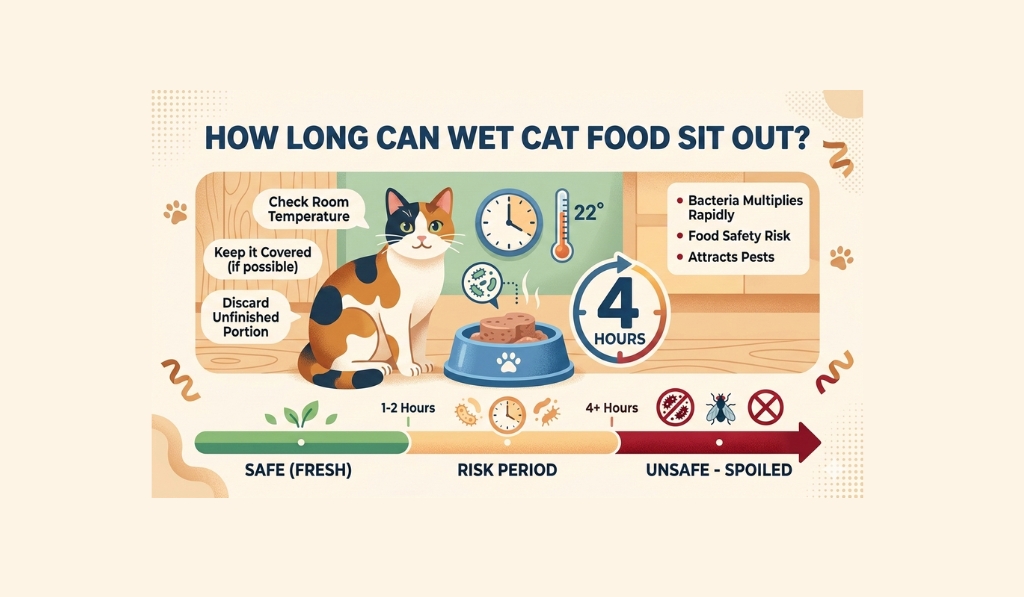
In general, wet cat food must not be allowed to remain at room temperature longer than four hours.
However, there is more to understand based on how hot your house is, the type of food you give your cat, and even the way it eats.
What Makes Wet Cat Food Spoil So Fast?
The content of wet cat food is very high in moisture, ranging between 70 and 80 percent.
Your cat will be very hydrated because of that moisture, but it will also provide the best environment by which bacteria grow.
Such foods are referred to by food safety experts as the temperature danger zone that lies between 40°F and 140°F (4°C and 60°C).
Bacteria like Salmonella and Listeria may begin to multiply in two hours after opening a can of wet food and placing it in a bowl as long as the temperature does not fall below 70°F.
At the fourth hour, your cat is likely to become ill due to the bacteria being sufficiently loaded into the food.
During hot summer seasons or in warm kitchens, this schedule becomes even smaller.
The 4-Hour Rule: How It Works in Practice
There is general consensus between most veterinarians and pet food manufacturers that a maximum of four hours is the safe range of wet cat food kept at room temperature.
This is applicable in the normal indoor environment between 65 and 75 degrees Fahrenheit. Provided that your home is warmer than that, make two hours your cutoff.
Four hours later the food is not only distasteful, it is actually dangerous. This is frequently spoiled, and the indications of this include a sour smell, sticky feel, or change in colour.
Trust your nose. When something smells bad, dispose of it irrespective of the time it has been lying outside.
Can You Leave Wet Cat Food Out Overnight?
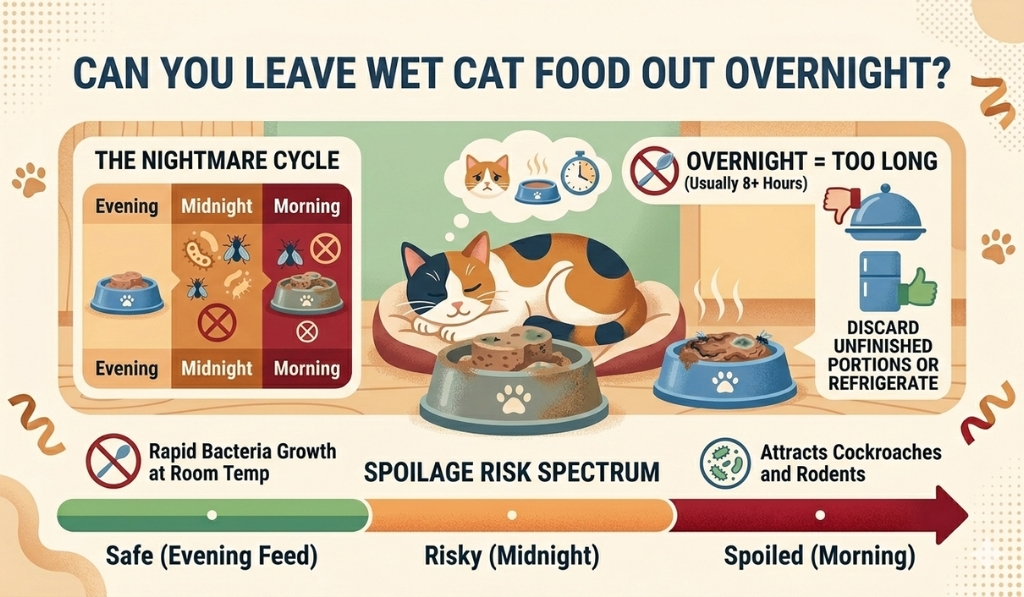
No. It is not safe to leave wet cat food overnight. Bacteria can attain levels that lead to food poisoning of cats within an eight- to twelve-hour period at room temperature.
The signs and symptoms of food borne illness in cats include vomiting, diarrhea, lethargy, and anorexia.
In case your cat has a habit of grazing at night, a timed automatic feeder or even a small amount of dry kibble can be offered instead of this habit.
Other owners of cats express their concerns as to whether or not it would be safe to leave wet food out there overnight, so long as the room is air-conditioned.
Overnight exposure is too extensive even in a cooler room. The best method to take out uneaten food is always to take it out in four hours and then refrigerate or dispose of the remaining food.
The Right Way to Store Leftover Wet Cat Food
Refrigeration of Opened Wet Cat Food
You can keep a can of wet cat food in the refrigerator by opening it and completely covering it with a plastic cat food can cover or press-fit lid.
When stored in a proper manner, opened cans containing cat food will last three to five days in the fridge.
Do not leave the can in the fridge without the cover, or it will dry up and take on the smell of other food.
Can You Freeze Wet Cat Food?
It is possible to freeze wet cat food. Divide it into ice cube trays or small containers that can be frozen in freezers and store it for not more than two months.
Always store portions in the fridge, never on the counter, and never refreeze thawed food.
It is also very handy when you make purchases in large quantities or when you need to preserve food that is about to expire.
How to Warm Up Cold Cat Food
Tons of cats are unloving of cold food. There is a chance that your cat does not like refrigerated wet food, so warm it up a bit.
Put the portion in a dish that can be heated using a microwave and heat it between five and ten seconds and stir it thoroughly to prevent hot spots.
Alternatively, put the sealed container in a bowl of hot water within a few minutes. This is done to bring the temperature nearer to the room temperature, rather than making it hot.
Quick Reference: Wet Cat Food Safety by Situation
Use the table below to quickly check whether wet cat food is safe based on the situation.
| Situation | Safe to Eat? | Max Time Out | What to Do |
| Fresh wet food, room temp (65–75°F) | Yes | Up to 4 hours | Discard after 4 hours |
| Wet food in warm room (above 80°F) | Risky | 1–2 hours | Discard sooner |
| Opened can, stored in fridge | Yes | 3–5 days | Cover tightly, refrigerate |
| Wet food left out overnight (8+ hrs) | No | Already spoiled | Throw it away |
| Cat food left in hot car | No | Under 1 hour | Never feed to your cat |
| Frozen wet food, thawed in fridge | Yes | 24 hours | Do not refreeze after thawing |
Does Canned Cat Food Go Bad Before You Open It?
Canned cat food with an unopened pack has a shelf life of between two to five years when it has been kept in a cool and dry environment.
Check the bottom part of the can for the date of expiration. Although the expired can with an intact closure is not likely to lead to an immediate sickness, the quality of nutrition suffers with time.
A bulging, rusted, or dented can must always be disposed of because it might contain harmful bacteria.
As soon as the can is opened, the clock begins. After air gets to the food, the notion of canned safety is no longer valid. Then make it like fresh meat henceforth.
Indications of Wet Cat Food Spoilage
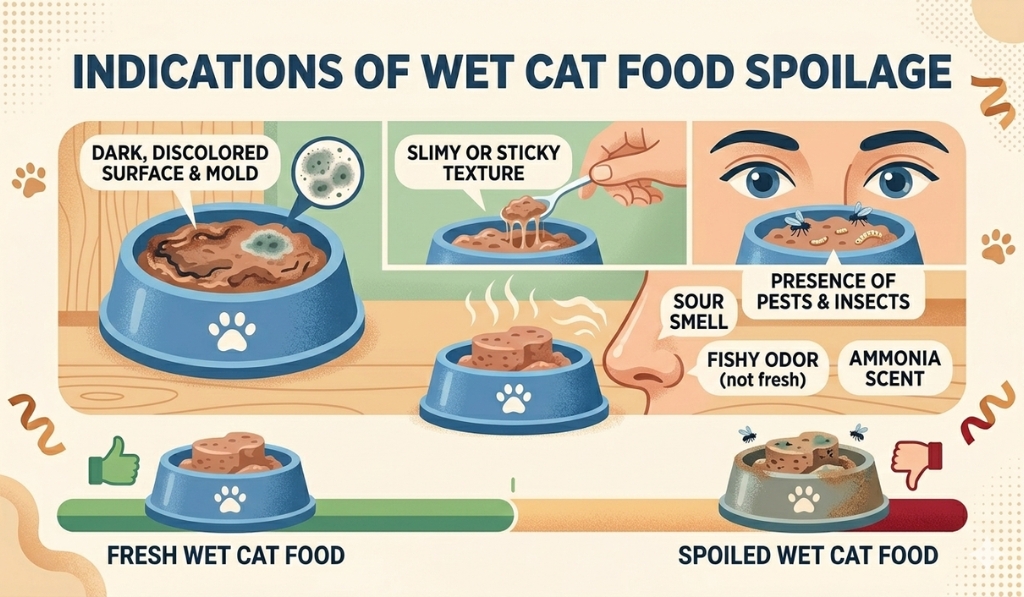
Training on how to tell when the wet food is spoiled saves your cat the unwarranted disease. Observe the following danger signs:
- A bad, acrid, or unpleasant odour.
- Sticky or oily feel to the food on the surface.
- Opposable mold or colour change.
- Your cat sniffs the bowl and goes away (cats have a way of knowing there is wrong stuff in it before we do).
- Any food that has been stored more than four hours at room temperature.
In case of uncertainty, discard it. Food poisoning is much more expensive than visiting a vet because of a can of cat food.
What is the wet cat food sitting life of kittens?
The sensitive nature of the digestive tract of kittens is even greater than that of adult cats, and the four-hour rule should be followed, and you might wish to take further precautions.
When you have a young kitten that is eating wet food, feed that little cat in smaller amounts but more often than having a large bowl of the food out.
When the kittens begin the weaning process at the age of four weeks, they can begin feeding on wet cat food.
Wet food is particularly significant at this age, as it is easy to consume and helps maintain healthy hydration.
Multi-Cat Home Advice and Slow Eaters
Other cats have a slow eating habit or return to the bowl during the day. This grazing practice is typical, and it poses food safety issues with wet food.
The following are some of the practical ways to deal with it:
- Eat less and more frequently instead of eating a single portion.
- Install an automated or programmed food dispenser to deliver fresh servings throughout the day.
- Attempt to have the bowl in a colder part of the house that does not receive direct sunlight.
- Replace part of the diet with dry kibble to graze all day long and the wet food in scheduled meal times.
- When away for long periods away from home, do not expect to find uneaten wet food still safe when you get back.
What About Wet Dog Food for Cats?
Provided you are in a pinch, cats can be fed little wet dog food without instant injury, but it is not a long-term answer.
Ta urine is an amino acid that cats need to maintain their heart and eye health, and dog food does not contain it.
The same applies to the food safety regulations; be it the cat or dog wet food, a time frame of four hours is the maximum time within which you should dispose of the food.
Frequently Asked Questions
How long can wet cat food sit out?
The maximum time that wet cat food can be left at room temperature (65 to 75 degrees Fahrenheit) is four hours.
During hot weather over 80 degrees, this should be restricted to one to two hours. Bacteria grow fast in damp food, and the longer your cat keeps the food, the higher his chances of food poisoning.
Can I leave wet cat food out overnight?
No, it is not safe to leave wet cat food overnight. Bacteria will have adequate time to develop harmful concentrations at room temperature (eight hours or more).
Any unused food should be removed in the course of four hours, refrigerating or disposing of the remainder. In the case of cats that graze at night, an automatic timed feeder with dry kibble is to be considered.
How long does opened canned cat food last in the fridge?
Canned cat food that is opened and stored in the fridge with a tight cover will remain successful for three to five days.
It should be covered with something all the time to avoid drying and uptake of odours. Always cover open cans in the fridge, and always check for any unusual smell before serving.
Can you freeze wet cat food?
Yes. Divide wet cat food into small containers that can fit in a freezer or ice cubes and freeze it and store it for not more than two months.
Freeze-thaw portions in the refrigerator, never on the counter. After thawing, allow consumption of food within 24 hours, and it should not be refrozen once more.
Does wet cat food need to be refrigerated after opening?
Any unused wet cat food should be refrigerated once opened, yes. Wrap the can or put the food into an airtight container.
Four hours later, leftovers in refrigerated condition must be discarded. When refrigerated properly, refrigerated food can be frozen for a period of three to five days.
Final Thoughts
The issue concerning the length of time that wet cat food can be kept out is not an ambiguous one: four hours of room temperature is the limit that can be safely taken.
And even more than that, you are putting your cat at risk of being exposed to dangerous bacteria that can make it really sick.
An adequate diet, including refrigerating your leftovers right away, covering them in cans, and serving the correct amount of food, plays a significant role towards the health of your cat and your sanity.
If you are still confused about the most appropriate feeding schedule or the most suitable storage procedure for your particular cat, discuss it with your veterinarian.
They are able to offer customised recommendations on the basis of the age, health, and nutrition of your cat.
Your cat is relying on you to ensure that their food is safe and fresh, and now you have all you need to make sure that is the case.