

Ever thought about how many teeth cat have? behind those cute whiskers Learning about cat teeth is essential to keeping your pet healthy in his or her mouth and overall in general.
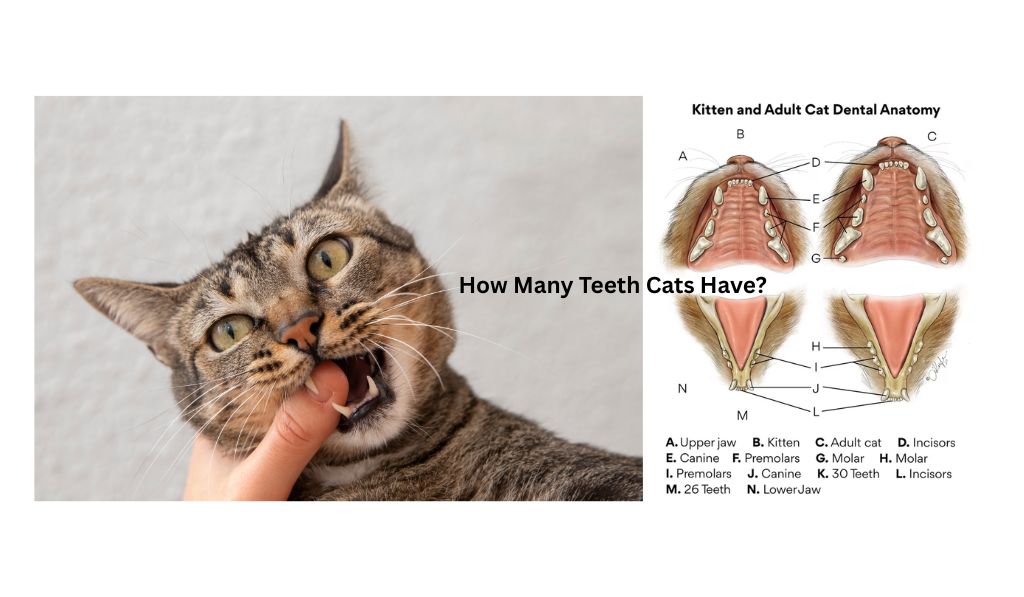
Adult cats possess 30 permanent teeth and the kittens have 26 baby teeth. Every tooth has a certain role to perform, whether it is in grooming or hunting, and the dental structure of the fields is the most suitable to their carnivorous lifestyle.
Count of teeth: The Primitives
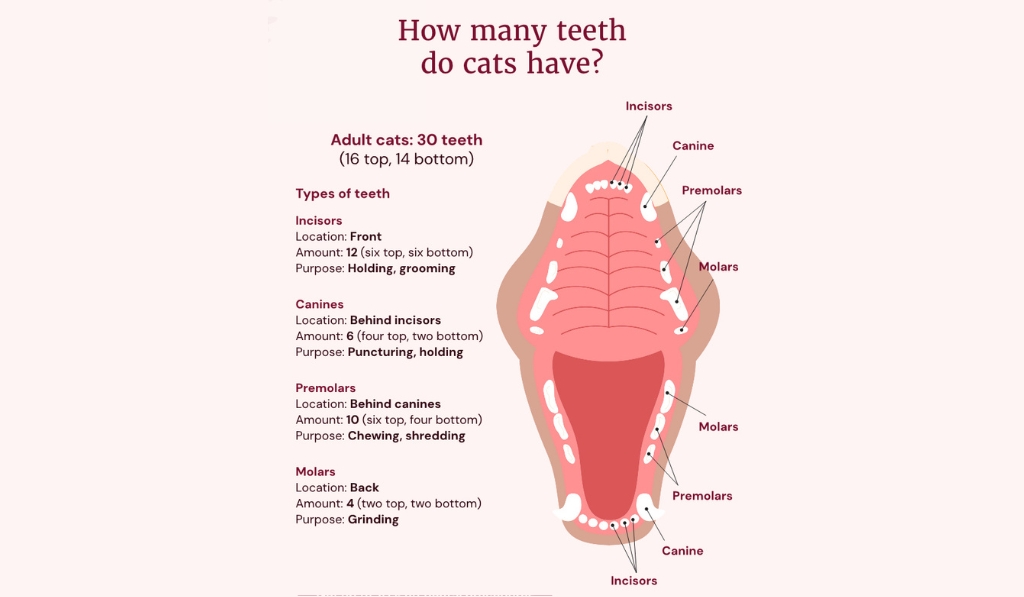
Adult cats have precisely 30 teeth which are evenly placed on the upper and lower jaws. This number consists of 16 teeth in upper jaw and 14 teeth in lower jaw. Kittens on the other hand are born with 26 deciduous (baby) teeth, which they then move into permanent teeth at the age of about six months.
The following is the breakdown of adult cat teeth:
- 12 Incisors (front teeth)
- 4 Canines (fangs)
- 10 Premolars (side teeth)
- 4 Molars (back teeth)
Developing the Knowledge of the various types of cat teeth
Incisors: The Little Teeth in front
The tiniest teeth are the cat incisors which are found at the front of the mouth. Cats possess 12 of this small teeth 6 on the top and 6 at the bottom. These are sharp and small teeth that have various functions such as grooming, picking and nibbling. When you get your cat grooming their fur, or picking up a bit of food with their incisors, they are using their incisors.
Canines: The Famous Fangs
The most noticeable teeth in the mouth structure of a cat are cat canines which are commonly referred to as fangs. These teeth are gripping and tearing teeth, four long, curved, pointed teeth (two up top and two down bottom). Wild cats apply canines to use fatal bites to attack their prey by cutting the spinal cord. The domestic cats have not lost these sharp hunting weapons hence the reason why a cat bite may be so deep and harmful.
Premolars: The Cutting Teeth
Cat premolars are serrated teeth that are found behind the canines. The number of teeth (10, including 6 upper, and 4 lower teeth) is known to act like a scissor, shearing and cutting food into easy-to-eat pieces. The 4th upper premolar and 1st lower molar collaborate in a pairing of, carnassial teeth, i.e. the greatest and most robust teeth which are meant to slice meat.
Molars: The Crushing Teeth
At the back of the mouth, there are cat molars. The number of molars in adult cats is 4 (2 upper, 2 lower) which are mostly utilized in crushing tougher substance. In contrast to the smooth surfaces of the grinding in the human molars, feline teeth do not have it, which is indicative of their pure carnivorous nature of the diet.
The stage of kitten teeth development
When do cats get their teeth? Knowing the cat dental chart based on the age assists in the discovery of the possible problems in advance:
- Birth to 2 weeks: The teeth of kittens are pointless.
- 2-4 weeks: The incisors of the baby start to emerge.
- 3-4 weeks: Canine teeth (baby fangs) are developed.
- 5-6 weeks: 26 baby teeth are evident.
- 3-4 months: The baby starts teeting, the baby teeth fall out.
- 4-5 months: Adults canines and premolars develop.
- 5-7 months: Adult molars develop
- 6-7 months: Final 30 adult teeth in place.
The teeth of the kitten are quite small, sharper and more clear compared to adult teeth. In the process of teeting you may get excessive chewing, minimal gum bleeding and drooling, which are normal. Fallen baby teeth are usually not found by their owners as they are often ingested by kittens.
Cat Teeth vs Other Animals
| Animal | Adult Teeth | Baby Teeth | Notable Difference |
| Cats | 30 | 26 | Purely carnivorous design; no grinding surfaces |
| Dogs | 42 | 28 | More teeth; some molars have grinding surfaces |
| Humans | 32 | 20 | Omnivorous design with flat molars for grinding |
This comparison highlights why cat dentition is uniquely suited to their obligate carnivore status. Every tooth is sharpened for capturing, killing, and consuming prey.
Common Cat Dental Problems
Periodontal Disease
Periodontal disease is the most prevalent problem of the cat teeth and it starts with accumulation of plaque which turns hard into tartar. The result of this accumulation of bacteria is inflammation of the gum (gingivitis), which may develop into the incurable periodontitis: loss of teeth and systemic health complications.
Tooth Resorption
Tooth resorption, which is progressive destruction, is a disease that affects 27-72 percent of domestic cats, and leads to the decay of teeth as they are destroyed internally. It is a very painful condition, which may need extraction, and is more prevalent in the aged cats.
Retained Baby Teeth
Retained deciduous teeth Sometimes it happens that the cat baby teeth do not drop off. This causes congestion, loss of alignment and early onset of tartar formation. Retained baby teeth are normally extracted immediately as advised by the veterinarians.
Broken or Fractured Teeth
Cat tooth fractures arise either through trauma, aggressive chewing or disease. A complex fracture which is exposing the pulp chamber causes infection and it should be immediately taken to the veterinary.
Normal Cat Teens: What Do They Look Like?
Healthy cat teeth should be:
- White or a little cream-colored.
- Devoid of plaque (brown/yellow formation)
- Surrounded by pink, firm gums
- Well spaced out and not too crowded.
- Smooth with no chips or cracks.
Poorly formed cat teeth present symptoms such as:
- Brown, yellow, or gray discoloration.
- Obvious plaque or tartar build up.
- Red, swollen, or bleeding gums
- Bad breath (halitosis)
- Loose or missing teeth
Age-Related Dental Changes
Kittens (0-6 Months)
Pay attention to mild treatment of the mouth with the aim of future dental treatment. Give proper teeting tools and keep track of the eruption patterns.
Young Adults (7 Months-2 Years)
Instituting brushing habits and preventive. Healthy pink gums and bright white normal cat teeth should be found at this age.
Adults (3-6 Years)
Monitor the development of dental disease. Out of every 3 years, two-thirds of cats older than 3 years old develop some type of dental disease, and periodical checkups are necessary.
Seniors (7+ Years)
Adverse effects on periodontal disease, resorption and tooth loss. The elder cats might require to be cleaned by the professionals more often and their diets to be changed.
Caring of Cat Teeth through all the stages
Daily Brushing
Apply cat toothpaste (human toothpaste is deadly to cats) and a soft bristled brush. Introduce it slowly: Get your cat used to the toothpaste by letting him taste it, and then slowly you can introduce brushing. Aim for several times weekly.
Dental Diet and Treats
There are particular kibbles that are aimed at decreasing plaque. Find products that are recommended by the Veterinary Oral Health Council (VOHC). Nonetheless, it is not dry food that stops the occurrence of dental disease; however, brushing is the most effective.
Professional Cleanings
Dental examinations that are performed on anaesthesia help the veterinarians to clean the teeth properly, inspect under the gum line, and also get a dental X-ray to identify the secret issues.
Water Additives and Dental Toys
Toys that are textured encourage natural cleaning and those that contain enzyme additives decrease bacteria in water. These are the complements but not substitutes of brushing and professional care.
Symptoms Your Cat is In Need of a Dental Procedure
Be aware of these red flags of cat dental problems:
- Persistent bad breath
- Problems with swallowing or with dropping food.
- Pawing at the mouth
- Excessive drooling
- Visible red or bleeding gums
- Behavioral or appetite alteration.
- Avoiding hard food
Timely treatment creates barriers to serious infections, excision pain, and complications of organs such as kidneys and heart, which are systemic health-related to the whole body.
Can Cats Live Without Teeth?
Yes! Cats are able to consume wet food and in some instances even dry kibble without some or all the teeth. Numerous cats whose dental conditions are treated through extractions of the painful teeth have many more positive feelings. A full set of teeth are not the best thing to live a healthy life with, but a pain-free mouth.
Curiosity: Fascinating Facts on Feline Teeth
- Cats do not develop holes as human beings do. Their tooth structure and low sugar diet reject conventional decay.
- Cat teeth don’t regrow. When the original 30 teeth are fixed, that is it, there is no replacement.
- The cat bites are dangerous as the needle like canines have the bacteria that go very deep into the tissue.
- The cats are diphyodont, i.e. they have two sequential sets of teeth as humans.
- Cat molars do not have any grinding surfaces, they are pure carnivores that do not require plant grinding.
Dental Concerns of Breeds
In brachycephalic breeds (Persians, Himalayans) with flat faces, it is common to have:
- Uproot teeth resulting in increased accumulation of plaque in the teeth.
- Increased prevalence of periodontal disease.
- Malocclusion (poor bite)
- Retained baby teeth
Such breeds have particular needs in terms of dental attention and an increased number of visits to the veterinary.
Conclusion:
It is not enough to know the number of teeth of cats. Proper dental health, such as brushing your teeth daily, taking them to the dentist once a year, and checking them when they show any signs of problems, keeps your cat with proper teeth in its lifetime. Whether it is a cat bottom tooth issue, checking the cat front teeth position or just keeping that cat dental chart, being on the offensive about oral hygiene helps dental issues avoid painful issues and costly surgeries in the future.
Frequently Asked Questions
Q: How many teeth do adult cats have?
Ans: Adult cats have exactly 30 permanent teeth—12 incisors, 4 canines, 10 premolars, and 4 molars.
Q: Do cats have baby teeth like humans?
Ans:Yes, kittens develop 26 baby teeth that fall out between 3-6 months of age, replaced by 30 permanent adult teeth.
Q: When do cats get their adult teeth?
Ans:Cats begin losing baby teeth around 3-4 months and have their complete adult set by 6-7 months of age.
Q: Can cats live without teeth?
Ans:Absolutely. Many cats adapt well to eating soft foods and maintain excellent quality of life after tooth extractions.
Q: Why do cats have fangs?
Ans:Cat canines (fangs) are evolutionary tools designed for grasping prey and delivering fatal bites—a remnant of their wild hunting ancestry.
Q: How often should I brush my cat’s teeth?
Ans:Daily brushing is ideal, but even 3-4 times weekly significantly reduces plaque buildup and prevents dental disease.
Q: Do all cat breeds have the same number of teeth?
Yes, all healthy adult cats have 30 teeth regardless of breed, though flat-faced breeds may have alignment issues.