


Have you ever slept down to find your cat snuggled up next to you purring? You’re not alone.Research indicates that more than 60 percent of cat owners sleep with their house cats.
Sleeping with cats is one of the best and popular experiences of pet owners in the world today.
It is a complete encyclopedia of all the facts you need to know about sharing your bed with your pet cat, how to deal with the cats that prefer to sleep with their owners, and how to get around the hardships involved in co-sleeping with your cat.
Why Cats Love Sleeping With You
It is not accidental that your cat wants to sleep with you, but it is based on serious biological and emotional requirements. During the most vulnerable time when cats are sleeping, cats demand warmness, safety, and companionship.
Warmth and Comfort
Cats are known to have a body temperature of 100-102 degrees Fahrenheit, which is a few degrees higher than that of the human beings.
When the night is colder, your body is your ideal warmness. This is the reason why a lot of cats like sleeping on a chair beside you until the day time and then go to your bed when it becomes cold.
Security and Trust
A cat sleeping next to you is showing extreme trust. Sleeping cats are also the most vulnerable because they are incapable of protecting themselves against any possible danger.
When your cat decides the bed to use, it is an indication that they are as safe as possible when you are around.
Bonding and Affection
The relationship between cats and their owners is similar to the relationships that cats had during their kitten hood with their mother and litter mates.
Cats that are napping instinctively strive to be near their most trusted individuals and babies are likely to tie you even tighter emotionally when they are physically by your side.
The Pros of Sleeping With Your Cat
Relaxation and Improved Quality of Mental Health
It has been found that co-sleeping with cats is a very effective way of stress and anxiety reduction.
The sound of purring is also rhythmic and it has the frequencies of 20-30 vibrations per second, which is therapeutic frequency of painful conditions.
Research findings show that cat owners are 40 percent less likely to get a heart attack than non-owners.
Improved Sleep Quality
A large number of individuals claim to fall asleep with their cat sleeping close by them. The purring has a white noise machine quality that covers the noises of the environment that are disruptive.
One of the women told how her lying cat was able to make her overcome her worst anxiety and have her lowest stress levels in years.
Warmth During Cold Nights
When it is colder, a cat that is sleeping next to you is a natural source of warmth and you do not need electric blankets. The reason is that they are good bedroom companions in winter because of their high body temperatures.
Strengthened Bond
Frequent nighttime cuddles increase your trust and love between the two (you and your cat).
This quality time togetherness makes your relationship stronger in a way that time available when you are busy with your day to day activities may not give you the time to strengthen your relationship.
Learning about the Cat Sleep Patterns
How Many Hours Do Cats Sleep?
Adult cats have a range of sleep that ranges to 12-18 hours a day and kittens may sleep up to 20-22 hours a day. This large sleep need is entirely natural and has to do with their evolutionary background as hunters, who store energy between hunting.
What is the average number of hours that a kitten sleeps? Kittens sleep almost 24 hours per day, which is slowly decreased to 18-20 hours at the age of three months. This sleep promotes the growth and development.
Cat Sleeping Time of the day
Cats are the species of the night, i.e. they are the most active at the dawn and the dusk. Knowledge of this natural rhythm is one reason as to why your cat may have sudden spurts of energy at a time when you are trying to sleep.
It is found to be the common cat sleeping time that occurs in several short naps in a day as opposed to a single long sleep.
Where shall Cats sleep at night?
At nighttime, where can cats sleep? The solution will lie in your family structure and preferences. Some of the popular sleeping places are:
- Your bed (preferred by 34% of cats)
- High side cat beds to ensure security
- High platforms on cat trees
- Cosy, draft less back rooms
- Small intimate places such as cardboard boxes
Cat Sleep Categories and Preferences
| Sleep Location | Benefits | Considerations |
| Owner’s Bed | Bonding, warmth, security | May disrupt sleep |
| Cat Bed | Independence, comfort | Requires proper placement |
| High Perches | Safety, observation | Accessibility for older cats |
| Enclosed Spaces | Security, privacy | Must be warm and clean |
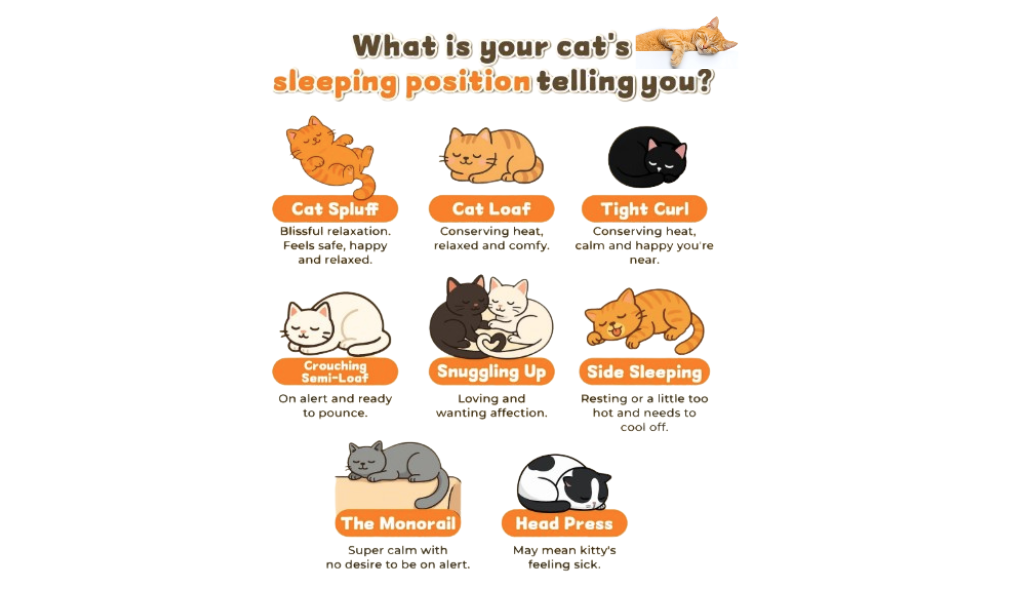
Cats Sleeping Positions
- Curl (loaf or ball) Keeps the body temperatures warm and safeguards the vital organs.
- Loaf position Paws rolled underneath the body, and will be in motion when required.
- Side sleeper: Recalls easy, cares well, demonstrates faith in environment.
- Belly-up shows the stomach, an indicator of being very safe.
- Breathing in Relaxing, and quite cooled down.
- Nose covered / face turned down Light blocking, warm.
- Paws over face Comfort position, even assists in light and noise.
- Squeezed another cat or human being Bonding and mutual coziness.
- Resting on his knee or half-upright, Light sleep, keeping watch.
Risks of Sleeping With Cats
Health Concerns
Though considered to be safe, you are likely to be health risk when sleeping with cats:
- Allergies and Asthma: It is estimated that there are about 10-20 percent adults with cat allergy. Physical approach during sleep may worsen the condition, leading to problems with breathing and disturbance of sleep.
- Parasites and Diseases: Outdoor cats could be carriers of fleas, ticks, or parasites such as Toxoplasma gondii. Well vaccinated and parasite-treated indoor cats should be of minimum danger.
- Litter Box Debris: Cats can carry litter on their paws and this may carry litter into your bed. This is minimized by regular cleaning of litter boxes.
Sleep Disruption
Cats are creatures of the night (actually, crepuscular) they are at their best when you are in bed. They may:
- Stomp over you in the dark
- Play in your legs in the wraps
- Meow for attention or food
- Engage in sudden zoomies
Studies indicate that 41 of individuals who share sleep with pets note improvements in sleep, and 20 of them get disturbed.
Special Considerations
Do not allow the cats to sleep with the infants or very young children because they will be suffocated. Cats can accidentally lie on the face of a baby or startle and scratch in case they are scared.
How to Get Your Cat to Sleep at Night
Creating a Bedtime Routine
What should I do to make my cat sleep at night? Use these strategies that have worked:
- Evening Play Sessions: Play intensively 30-60 minutes before going to sleep. Get interactive toys to pretend you are hunting, and wear your cat out doing it.
- Before Bed: Have dinner just before your bed time. Having a full stomach will make cats sleep.
- Gradual Schedule Adjustment: Modify gradually your cat active periods to suit your schedule with regular interaction times.
Making the Perfect Cat Sleep Place
The best place to sleep cats comprises:
- Soft, washable bedding
- High places as a means of protection
- Noise-free surroundings of the house
- Hot areas that are well temperature regulated
- There are a variety of choices around your house
What is the favorite color of cats to sleep in? Although cats do not perceive colors the way humans do, they are more attracted to warm and neutral colors and also they like soft textures instead of certain colors.
Controlling problems of Common Sleeps
The Puppy Diaries: How to Get Your Cat to Sleep at Night
How shall I get my cat to sleep at night? Use the following effective methods:
- Ensure that cats are made mentally active during the day through puzzle feeders and toys
- Have regular feeding and play routines
- Give you food, water, litter, without bothering
- Night snacking Use automatic feeders
- Prepare sleep able spaces in serene areas
Addressing Nighttime Activity
In case my cat sleeps during the day and is active at night, then you should give him more interactions during the day. Arrange frequent playing time, and think of adopting a second cat to play with.
Apprehending the Kitten Nap
The kitten patterns of nap are not the same as adult cats. Flaps Young kittens require numerous brief naps of 18-22 hours a day. Always leave a sleeping kitten alone to sleep- their sleep brings about vital development.
Why Does my Cat Like to Sleep on my Lap?
Why does a cat want to sleep on my lap? This behavior indicates:
- Deep trust and affection
- Seeking your body warmth
- Lust to be safe and comfortable
- Marking you with their scent
- Feeling the beat of your breath and heart
Special Sleep Situations
Three Sleeping Cats Management
Several cozy sleeping places inside your house would be adequate to control 3 sleeping cats. A cat requires a space of their own, but bonded cats cuddle.
Cat Sleeping on a Chair vs. Bed
When your cat sleeps on a chair rather than on your side, then it is not a personal thing. Cats like to keep their temperatures low and therefore when it is hot they prefer colder environments whereas when it is colder they prefer warmer places.
Phenomenon of Sleeping Cats Light
Other owners have a sleeping cat light or nightlight to keep checking on the pets but not to disturb them. Cats like dark places to sleep like in their natural hunting times, which is twilight.
The development of a Sleep-Friendly Space
Classified: Best practices of cat owners
- Keep your Vet appearances: Frequent check-ups, vaccinations, parasite control make sure that it is safe to sleep with cats.
- Good Hygiene Practice: Wash hands after picking litter boxes and prior to food preparation.
- Keep Bedding Clean: Laundry sheets once a week to reduce exposure to allergens.
- Show Respect: Respect Boundaries: Do not demand that cats be near you, permit them to be free.
- Watch Health: Rapid alterations in sleep patterns can be a sign of some health problems.
When to Visit Your Veterinarian
Call your vet in the event that you notice:
- Radical growth in duration of sleep
- Decreased energy when awake
- Difficulty waking your cat
- Alterations in sleeping places which indicate pain
- Incontinent night time vocalization
Conclusion
There are many advantages of sleeping with cats, including the reduction of stress and enhancement of mental well-being, as well as the development of strong relationships and warm companionship.
Although there are certain issues, such as that it may cause some sleep problems and there are some minor health issues, the benefits of keeping a cat outweigh the cons by far in most cases.
By knowing how your cat prefers to sleep in nature, providing your cat with cozy atmosphere to sleep, and taking proper care of your cat, you and your sleepy feline have guaranteed comfortable and positive nights.
Be it on your pillow, your feet, or their own area, these night routine activities symbolize the human-cat connection that is so unique between a human and his or her favorite cats.
Remember, every cat is unique. What is effective in one cat might not be effective in another. Learn to listen to your cat and observe his or her preferences, keep within the confines, and have the privilege of being a preferred Sleeping partner by your cat.
Frequently Asked Questions
Q1: Is it safe to sleep with my cat every night?
No, and in the majority of cases with healthy adults the sleeping with cats is not dangerous. Get your cat to a vet frequently, have him or her prevented against parasites and vaccinated. Individuals and people who have weakened immunity or extreme allergies must consult their physician.
Q2: How do I stop my cat from waking me up at 3 AM?
Create an evening play ritual, eat and sleep, leave the bedroom door ajar in order to go to the bathroom, and offer leisure facilities outside your bedroom. Regularity is of essence–do not be tempted to attend to the nighttime demands or to feed.
Q3: Why does my cat sleep on my head?
Cats like sleeping on heads since they are the warmest areas of your body and are the nearest to your smell and are secure. Should this annoy you then shift your cat through other sleep areas in a gentle manner providing him with other appealing options like the use of heated cat beds.
Q4: Can sleeping with my cat make me sick?
The risk of falling ill due to sharing the bed with a cat is very minimal to healthy people. It is estimated that the risks of getting such serious diseases as plague and meningitis through well taken care of indoor cats are one in 80,000 to one in 4 million -which is equivalent to the odds of getting struck by lightning.
Q5: Do cats prefer sleeping with certain people?
Yes, cats usually get along best with their main caregiver, usually the one who feeds them, spends the most time with them, or of the same energy level. Nevertheless, cats can select other members of the family on other nights depending on comfort, temperature and mood.
Q6: Should I let my kitten sleep with me?
Allow bed sharing only after kittens have attained the age of six months. Young kittens might have difficulties getting to high beds to use litter boxes and they can fall and be hurt. Good sleeping habits should be promoted early as proper kitten sleeping environments should be provided.
Q7: What does it mean when my cat sleeps touching me?
Trust, affection, and seeking security are manifested when your cat sleeps with you and is touching you. I feel more comfortable with you around, and you are physically touching me, which enables your relationship.